
Different Types of AI – Everything You Need To Know

Loading...

Artificial intelligence (AI) is increasingly shaping our daily experiences, underscoring the importance of keeping pace with its evolution. Understanding the different types of AI, from the most common type used today to the various forms AI might take, provides a glimpse into its potential future, especially as AI systems begin to mirror more complex human cognitive functions. Grasping the multiple types of AI and how many types of AI is crucial for anticipating its future trajectory. Continue reading to explore the ultimate potential of different types of artificial intelligence.
Artificial Intelligence (AI) represents the replication of human intellect in machines designed to think and behave similarly to humans. This technology encompasses the development of algorithms and computational models that enable machines to perform tasks requiring human-like cognitive processes such as learning, reasoning, problem-solving, perception, and language understanding.
AI systems leverage machine learning, deep learning, and rule-based programming techniques to process data, learn from it, and make autonomous decisions. The ultimate objective of AI is to create systems capable of performing complex tasks intelligently and independently, mirroring the multifaceted aspects of human intelligence.
Let’s find out what the types of AI:
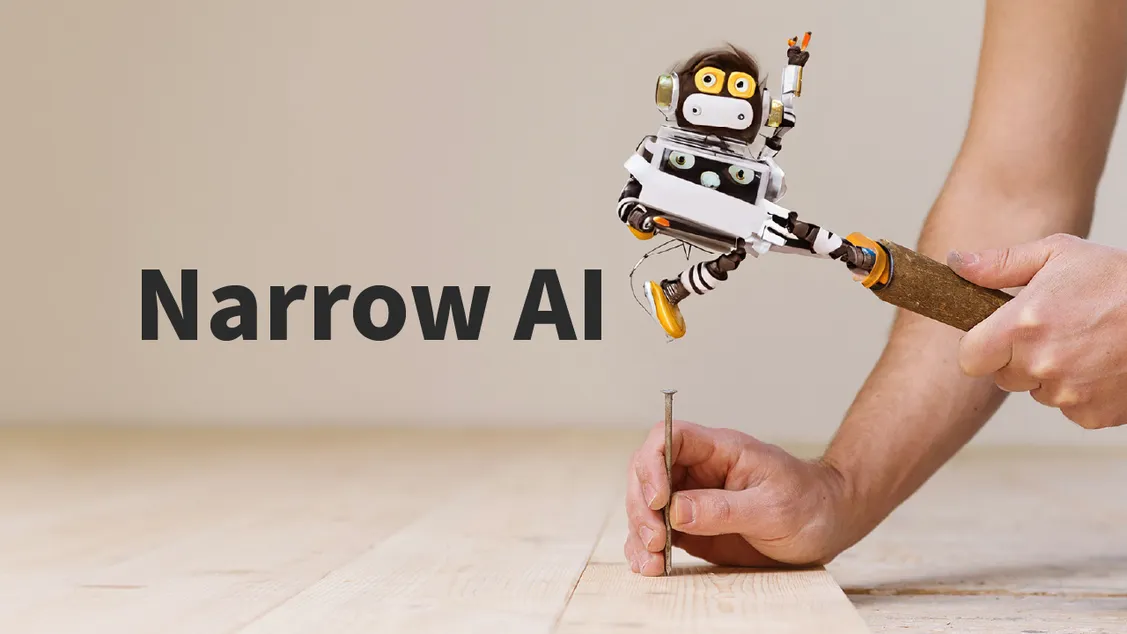
Narrow Artificial Intelligence, commonly known as Narrow AI, is the predominant form of AI today. It’s found everywhere, from smartphones and online platforms to advanced data analysis systems.
Narrow AI, one of the different types of AI, is designed with a specific purpose, focusing on executing a singular or a limited range of tasks. Because of this focused functionality, it’s often referred to as ‘weak’ AI. Its capabilities are confined to its programmed tasks, making it highly specialized and efficient.
Key Features:
Advantages:
Limitations:
If you are asking, “What is the most common type of AI used today?” The answer is General Artificial Intelligence (AGI), or strong AI. This advanced form of AI aims to mirror human cognitive abilities comprehensively. Unlike narrow AI, which is tailored for specific tasks, AGI is designed to understand, learn, and adapt broadly and autonomously, handling complex tasks like humans. This includes both perceptual tasks, advanced cognitive functions, and unsupervised learning.
However, achieving AGI is a significant challenge. Current technologies, such as neural networks, are steps towards AGI, but understanding human intelligence—a prerequisite for AGI—remains a complex puzzle. Moreover, integrating ‘consciousness’ into AGI adds another layer of complexity, making it a goal still out of reach with today’s tools.
Key Features:
Advantages:
Limitations:
Learn More On:
Artificial Super Intelligence (ASI) refers to an AI that vastly surpasses human intelligence in every aspect. While still theoretical, ASI is seen as the ultimate aim of AI evolution. It’s thought to emerge from an ‘Intelligence Explosion,’ a rapid surge in AI capabilities through recursive self-improvement.
This process, a hallmark of what are the different types of AI, involves AI enhancing its intelligence and then using it for further self-improvement, leading to a swift and continuous escalation of capabilities. However, actualizing or managing ASI remains beyond our current reach, positioning it more as a concept for science fiction.
Key Features:
Advantages:
Limitations:
Artificial Intelligence (AI) has evolved into a transformative power in diverse industries, reshaping how we live, work, and interact. Its broad and multifaceted applications touch upon almost every aspect of our daily lives and business operations.
| Enhancing Decision-Making | AI aids in making informed decisions by analyzing vast amounts of data, identifying patterns, and predicting outcomes. This capability is crucial across sectors, from strategic business planning to critical healthcare interventions. |
| Automating Routine Tasks | AI excels in automating repetitive and mundane tasks, freeing human resources for more creative and complex activities. This automation extends from simple administrative tasks to complex manufacturing processes. |
| Improving Customer Interactions | AI personalizes customer experiences by understanding individual preferences and behaviors. Whether through tailored product recommendations or responsive virtual assistants, AI is at the forefront of customer engagement. |
| Optimizing Operations | In various industries, AI optimizes operational efficiency. It streamlines supply chains, predicts maintenance needs, and optimizes resources, leading to cost savings and enhanced productivity. |
| Driving Innovation | AI is a catalyst for innovation, fostering the development of new products, services, and business models. It encourages creative problem-solving and opens up new possibilities for growth and advancement. |
Economic Transformation: AI is a significant driver of economic growth, contributing to increased productivity, the creation of new markets, and the evolution of existing industries. It’s reshaping the economic landscape, offering both opportunities and challenges.
Societal Evolution: AI impacts societal norms and daily life. It influences education, healthcare, and social interactions, offering new learning tools, enhancing healthcare accessibility, and changing the way we connect with others.
Ethical and Privacy Implications: The pervasive use of AI raises important ethical and privacy issues. Concerns about data security, algorithmic bias, and the ethical use of AI are prompting discussions and policy considerations worldwide.
Workforce Transformation: AI is altering the job market, automating certain tasks while creating new roles and industries. This shift necessitates focusing on reskilling and education to prepare the workforce for the evolving demands of an AI-driven economy.
Addressing Global Challenges: While AI offers prospects for expansion and innovation, it also presents obstacles in guaranteeing fair access and mitigating potential inequalities. Ensuring that AI benefits are shared globally requires concerted efforts and inclusive policies.
Artificial Intelligence (AI) is a beacon of innovation, reshaping industries and redefining possible boundaries. AI’s influence is profound and pervasive, from enhancing decision-making and automating routine tasks to revolutionizing customer interactions and driving economic growth.
However, navigating the complexities of the different types of AI requires expertise and foresight. This is where TECHVIFY steps in. As a top company providing AI services, TECHVIFY is dedicated to unlocking the full potential of AI for your business. Contact TECHVIFY today. The future is AI, and with TECHVIFY, you’re poised to lead.
TECHVIFY – Global AI & Software Solution Company
From Startups to Industry Leaders: TECHVIFY prioritizes results, not just deliverables. Accelerate your time to market and see ROI early with high-performing teams, AI (including GenAI) Software Solutions, and ODC (Offshore Development Center) services.